

A score you can check, and a fix guide for every problem
PixyScan runs 200+ checks on every page and gives your site a health score out of 100. Each check comes with a guide written by a person, and every problem shows the points it costs.
Does this sound familiar?
A list of 300 problems is not a plan. You need to know which one to fix first, and how.
- You get a score, and no way to see how it was worked out.
- You get a long list, and no idea which problem to fix first.
- You search the web for how to fix each one, and find five different answers.
How it works
How it works, in three steps
PixyScan checks every page against 200+ search, AI and technical checks and gives your site a health score out of 100.
- Step 1
Add your site
Enter your site's address. There is nothing to install. PixyScan reads your robots.txt and sitemaps, then follows the links from your home page.
- Step 2
Run a scan
PixyScan runs 200+ checks on each page it finds and gives the site a health score out of 100. Each page uses one URL credit from your monthly allowance.
- Step 3
Fix from the top
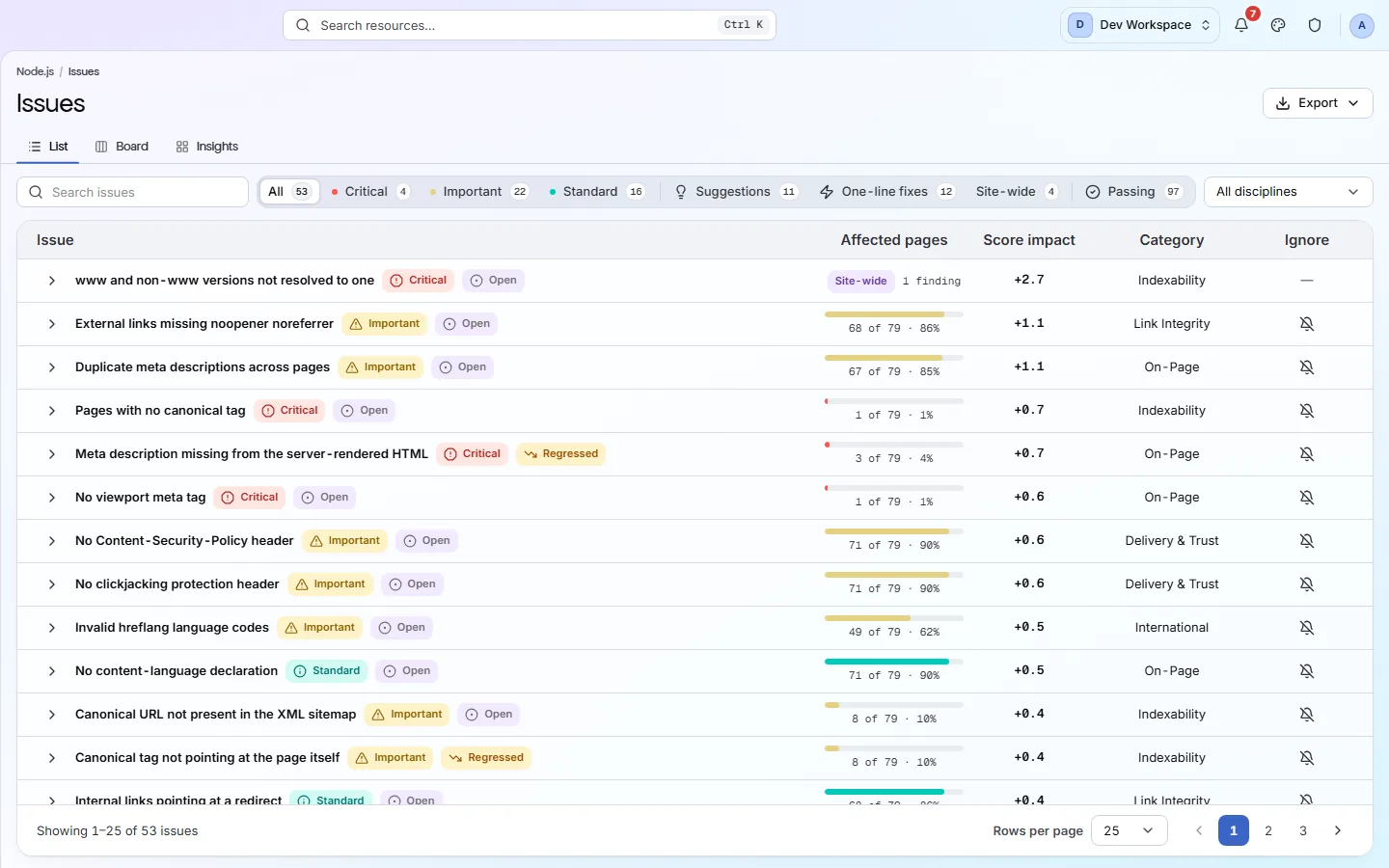
The Issues view puts the problems that cost the most points first. Open one to see its pages and its fix guide, fix it, then scan again.
What you get
What you get with it
You get one list of problems, biggest first. Each one shows the pages it affects, the points it costs and a guide to fixing it.
- 01
200+ checks in 10+ categories
The checks cover crawling, indexing, links, page tags, content, structured data, images, social tags, languages, and speed and security. 167 are scored problems. The other 35 are suggestions that never cost points.
- 02
A health score that is not a secret
Each failing check costs points. Serious problems cost more, and so do problems on more pages. Every problem shows the points it costs, and the full formula is published on this site.
- 03
The pages behind every problem
Each issue lists the exact pages where it was found. A mistake in one template shows as one issue across many pages, not hundreds of separate issues.
- 04
A fix guide beside every issue
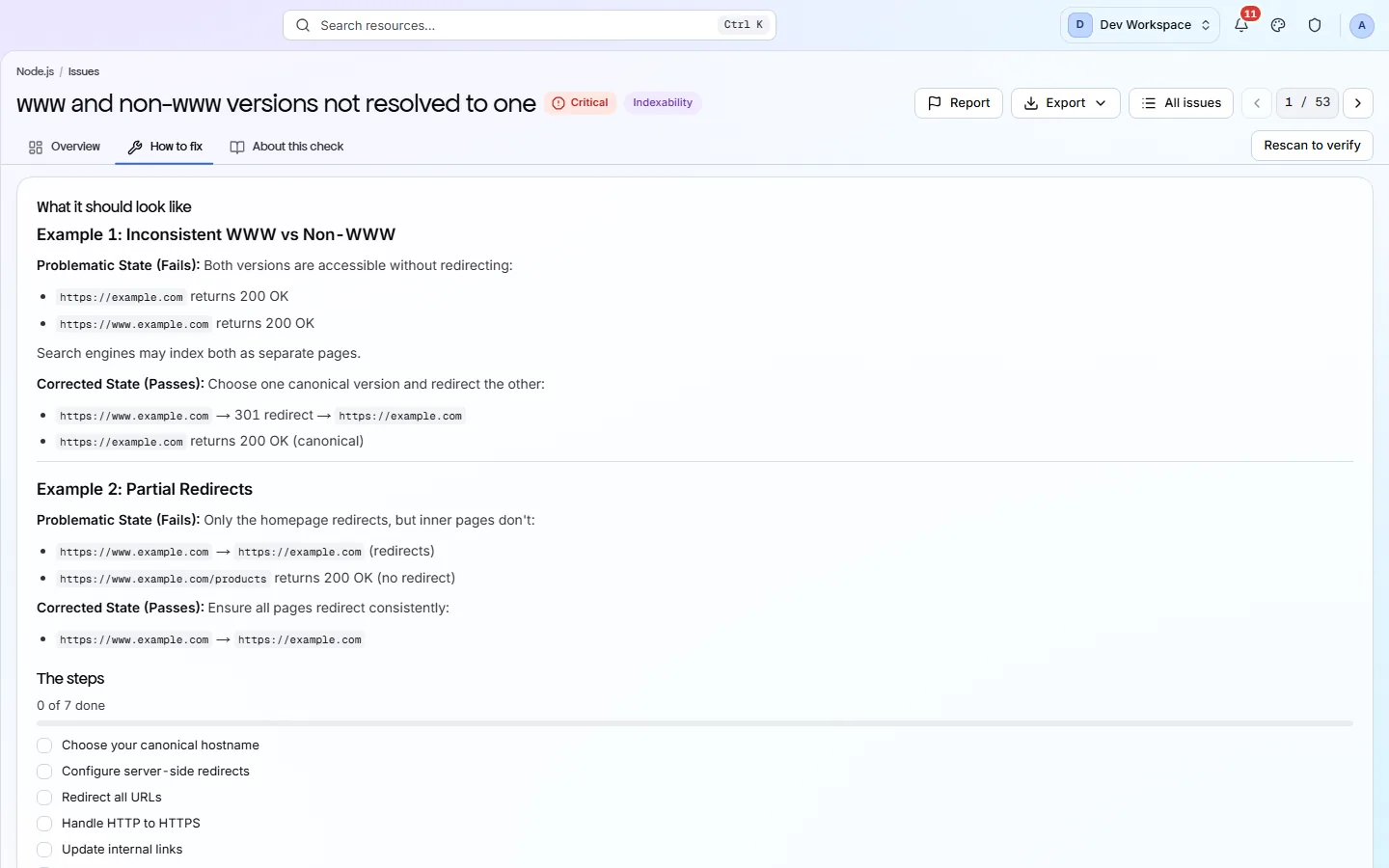
Each check has a written guide: what the problem is, why it matters and how to fix it, with examples. No language model writes them, so the advice is the same every time you read it.
Which tiers include it
Every tier. Free runs 181 of the 200+ checks. Hobby and above run all of them.
- Free runs 181 checks. The other 21 (broken and redirecting outside links, broken images and 18 page-speed checks) start on Hobby.
- Core Web Vitals (Google's measures of page speed and stability) and Lighthouse page-speed audits start on Hobby and need your own Google API key.
- JavaScript rendering, where a real browser loads each page, starts on Pro.
- Most pages in one scan: 500 on Free, 5,000 on Hobby, 10,000 on Basic and 15,000 on Pro.
What it doesn’t do
- It never changes your site. You or your developer make each fix.
- No AI writes content or fixes. Every fix guide is written by people.
- No keyword research, rank tracking or backlink data.
- Every area runs on every scan. You can limit a single check to certain URLs, or exclude URLs from it.
Why use it
When it helps
Everyday moments where it saves you time or catches a problem early.
A first full check-up
Your first scan lists every problem, the pages it is on and how to fix it. Later scans are compared with this one.
Deciding what to fix first
Work down the Issues list from the top. A problem on every page can be worth more than a critical one on a single page.
A check that does not fit part of your site
In Settings → Ignored issues, stop a check being reported on certain URLs. Ignored problems still count in the score, because hiding is not fixing.
Where to find it in the app
Take the product tourUnderstand
Issues
The Issues view lists every check your site fails. The fix worth the most points is at the top. Open any row to see the pages affected and a guide to fixing it.
Understand
Site overview
The Overview is the first view you see for a site. It shows your health score, what changed since the last scan and where the problems are. Click any number to see the detail behind it.
Explore
Content
The Content view checks the title, description, headings and word count of every page in one place. It shows which are missing, copied from another page, too long or too short, and which pages are thin or hard to read.
Explore
Schema
Structured data is a small block of code (JSON-LD) that tells search engines what a page is: a product, an article, an event, a business. The Schema view lists every block on your site, which ones are broken, and which fields they are missing.
Explore
Social
When someone pastes your link into LinkedIn, Slack, WhatsApp or X, the preview card comes from a few tags in your page's code. The Social view shows which pages would share as a bare link with no image, and exactly which tags are missing.
Explore
Performance
Slow pages lose visitors and rank lower. The Performance view times every page the scan visits, lists every script, stylesheet and font your pages load, and, with your own Google API key, shows Google's Core Web Vitals.
Explore
Trust
Browsers warn visitors away from sites with expired certificates or unsafe files, and search engines notice too. The Trust view checks your SSL certificate, your security headers and any file still loaded over plain http, on every page.
Questions
Common questions
Short answers about tiers, setup and limits.
What do the checks cover?
They are grouped into ten areas: On-Page (35), Structured Data (22), Link Integrity (26), Delivery & Trust (37), Crawlability (18), Social & Sharing (13), Content & Answers (12), Indexability (24), Media (8), International (7). Every area runs on every scan.
What is the difference between an issue and a suggestion?
167 checks are issues. They are rated critical, important or standard, and they cost points. The other 35 are suggestions: useful advice that costs no points.
Do I need to install anything?
No. PixyScan reads your site from the outside, like a search engine does. There is no plugin or code to add.
Does it check page speed?
Yes, from Hobby up. After each scan, PixyScan tests a sample of pages with Google PageSpeed Insights, using your own Google API key.
Does it work with JavaScript sites?
Yes, from Pro up. Choose JavaScript rendering in Settings → Crawl. Scans take about 7.6 times longer, so use it only if your pages build their content in the browser.
Does it fix problems for me?
No. PixyScan never changes your site. Each check has a written guide, and you or your developer make the change.
Other features
All featuresPages, links and images
Browse every page, link and image the scan found, and open any page for its full report.
ReadReports and exports
Turn any scan into a report or data file: 61+ kinds, in PDF, CSV, XLSX, JSON or Markdown.
ReadWorkspaces, sites and roles
Put your sites and your team in one workspace, and give each person only the sites they need.
ReadSee what is wrong with your site
Add your site and get your score, your to-do list and a fix guide for every problem. Free for one site and 500 pages a month, with no time limit.
Nothing to install · Cancel any time